Selasa, 26 November 2019

At least 14 killed, 325 injured, as 6.4-magnitude earthquake strikes Albania - CNN

The quake, which had a preliminary rating of 6.4 magnitude, hit the European nation at an approximate depth of 20 kilometers (12 miles) early Tuesday local time, according to the United States Geological Survey.
The epicenter was in the port city of Durres, about 36 kilometers (22 miles) from the capital Tirana. Social media videos from the area show several buildings have collapsed.
Albanian Prime Minister Edi Rama's office revised the death toll upwards several times on Tuesday. At least four victims died in Durres, a spokesperson for Rama told CNN. Another two died in Thumane, one person died after jumping from a building in panic in Kurbin, and one victim died while driving on a badly damaged road in Lezhe, the spokesperson added.
The health ministry had earlier confirmed that at least 325 people were injured in the quake, and the Prime Minister's office has said that several people are still missing.
Nearby Bosnia and Herzegovina was also struck by an earthquake on Tuesday morning, the country's interior ministry told CNN. That quake had a 5.4 magnitude rating.
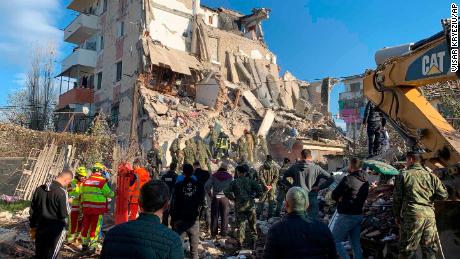
Rescuers search a damaged building in Thumane, Albania on Tuesday morning.
Rama said nearby countries, including Italy and Greece, have been assisting Albania with the recovery operation, while other European leaders have also offered their assistance.
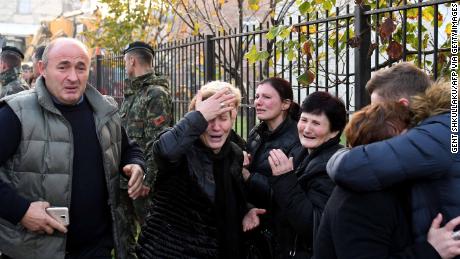
Relatives of people living at a collapsed building in Thumane wait for news on Tuesday.
Schools have been closed in three cities -- Durres, Lezhe and Tirana -- until further notice.
Correction: This story has been updated to amend the distance between the quake's epicenter and Tirana.

Let's block ads! (Why?)


https://news.google.com/__i/rss/rd/articles/CBMiU2h0dHBzOi8vd3d3LmNubi5jb20vMjAxOS8xMS8yNi9ldXJvcGUvYWxiYW5pYS1lYXJ0aHF1YWtlLXRpcmFuYS1pbnRsLWhuay9pbmRleC5odG1s0gFXaHR0cHM6Ly9hbXAuY25uLmNvbS9jbm4vMjAxOS8xMS8yNi9ldXJvcGUvYWxiYW5pYS1lYXJ0aHF1YWtlLXRpcmFuYS1pbnRsLWhuay9pbmRleC5odG1s?oc=5

2019-11-26 13:41:00Z
52780448646920

Albania hit by 6.4-magnitude earthquake, killing at least 7, injuring 300 - The Washington Post

Albania was struck Nov. 26 by its strongest earthquake in decades. It killed at least seven people and injured 300.

ROME — Albania was struck early Tuesday by its strongest earthquake in decades, killing at least seven and injuring 300 according to the Associated Press, raising fears that more people might be buried under the rubble.

The U.S. Geological Survey said the 6.4-magnitude earthquake caused tremors throughout the Balkans into southern Italy. Its epicenter was along Albania’s western coast, just north of the port city of Durrës. The earthquake came just before 4 a.m. local time and originated from a fairly shallow depth, just 12 miles underground. Shallow quakes tend to cause more damage than deeper ones, because their waves lose less energy before reaching the surface.

The Associated Press said that three apartment buildings had fallen during the night and it was unknown how many people might be trapped.

Citing Albania’s Defense Ministry, the AP said that one person who lived 30 miles north of the capital, Tirana, died after jumping from his home in an attempt to escape. According to Reuters, two other women were found in the rubble of an apartment building in the town of Thumanë.

Albania’s president, Ilir Meta, said on Twitter that the situation was “dramatic” in that town, and that everything must be done to save people “stuck under the ruins.”

A government spokesman said that more than 300 people have received medical help at hospitals in Tirana and Durrës.

Videos on social media showed collapsed and damaged buildings, cars demolished by rubble, cracks in sidewalk, and people fleeing into the streets after the shaking. Rescue teams waded through rubble, carrying stretchers, as volunteers mounted their own efforts.

Hektor Pustina

AP

People stand near a damaged building after a magnitude 6.4 earthquake in Durres, western Albania, Tuesday, Nov. 26, 2019.

Three aftershocks, with magnitudes between 5.1 and 5.4, followed in the aftermath of the initial quake. Another earthquake, with a recorded magnitude of 5.4, was reported to the north in Bosnia.

“Our country was hit by a wave of earthquakes like never before in the darkness of the early hours of today!” Meta said in a statement. “It is important to work with dedication and professionalism to save every human life under the rubble of buildings and to help the injured. It is important to identify residents who cannot return to their homes and who need housing.”

Italy and Greece were among the countries offering to assist in the rescue work.

Albania is one of Europe’s poorest countries and has been in long discussions to join the European Union.

It is the second time in two months that Albania has been hit by a significant earthquake. In September, a 5.6-magnitude tremor hit roughly the same area and caused dozens of injuries. It was said to be Albania’s most powerful earthquake in 30 years.

Read more

In Albania, age-old traditions and Mediterranean beaches on the cheap

A terrifying preview of ‘The Big One’ — a giant quake that may hit Southern California

Scientists claim progress in earthquake prediction

Today’s coverage from Post correspondents around the world

Like Washington Post World on Facebook and stay updated on foreign news

Let's block ads! (Why?)


https://news.google.com/__i/rss/rd/articles/CBMirQFodHRwczovL3d3dy53YXNoaW5ndG9ucG9zdC5jb20vd29ybGQvZXVyb3BlL2FsYmFuaWEtaGl0LWJ5LTY0LW1hZ25pdHVkZS1lYXJ0aHF1YWtlLWtpbGxpbmctYXQtbGVhc3QtNC1pbmp1cmluZy0xNTAvMjAxOS8xMS8yNi9hNDdkOWU5NC0xMDE4LTExZWEtOTI0Yy1iMzRkMDliYmM5NDhfc3RvcnkuaHRtbNIBvAFodHRwczovL3d3dy53YXNoaW5ndG9ucG9zdC5jb20vd29ybGQvZXVyb3BlL2FsYmFuaWEtaGl0LWJ5LTY0LW1hZ25pdHVkZS1lYXJ0aHF1YWtlLWtpbGxpbmctYXQtbGVhc3QtNC1pbmp1cmluZy0xNTAvMjAxOS8xMS8yNi9hNDdkOWU5NC0xMDE4LTExZWEtOTI0Yy1iMzRkMDliYmM5NDhfc3RvcnkuaHRtbD9vdXRwdXRUeXBlPWFtcA?oc=5

2019-11-26 09:54:00Z
52780448646920

Stung by Hong Kong vote, China slams Reuters report on liaison office shake-up - The Washington Post

Ng Han Guan AP Protesters in Hong Kong hold up their hands to represent their five demands in front of the Chinese and Hong Kong flags on Nov. 15. Local elections in the financial center on Sunday delivered a rebuke to Beijing.

BEIJING — China’s Communist Party admonished the Reuters news agency Tuesday over what the party called a “false report” about a move to replace the head of the government’s Hong Kong liaison office for failing to foresee the resounding defeat of the pro-Beijing establishment in local elections last weekend.

Reuters reported Tuesday that the Chinese leadership had set up a crisis command center in a luxury villa on the outskirts of Shenzhen, on the mainland side of the border with Hong Kong, to deal with the long-running political unrest in the semiautonomous financial hub.

The report said Beijing was considering replacing its most senior official stationed in Hong Kong, liaison office director Wang Zhimin, because it was dissatisfied with his handling of the crisis.

In a stunning rebuke to Beijing, Hong Kong residents gave an overwhelming majority to pro-democracy candidates running in local elections held Sunday. Voters handed control of 17 of the territory’s 18 councils to representatives who oppose China’s increasing influence, giving the pro-democracy camp greater say in the choice of Hong Kong’s next leader.

The Foreign Ministry’soffice in Hong Kong said Tuesday that it had lodged “solemn representations” with Reuters about the “false report.” It said it had urged the agency “to uphold a true, professional and responsible attitude, and immediately stop spreading false information.”

In Hong Kong elections, big defeat for elites pressures Beijing to rethink approach]

The ministry has insisted throughout the six months of protests in Hong Kong that the unrest is an internal domestic matter and that China will never waver from the “one country, two systems” formula under which Britain returned Hong Kong to China in 1997.

Under that framework, Hong Kong is supposed to enjoy a degree of autonomy and relative political freedom until 2047, but its residents are bristling at Beijing’s increasingly muscular control over the territory. Tensions burst into the open in June, when the Beijing-backed Hong Kong government moved to implement a law that would have allowed Hong Kongers to be extradited to the mainland.

Ju Peng

AP

Chinese leader Xi Jinping, right, with Hong Kong Chief Executive Carrie Lam in Shanghai earlier this month.

Hong Kong has a much stronger and more transparent rule of law than the mainland, and many residents feared that the proposal, which has since been scrapped, could be used to target Beijing’s critics.

The Reuters report, which cited Chinese officials briefed on the discussions, said that Chinese leader Xi Jinping and other top officials have been receiving daily written briefings from the villa, named “Bauhinia” after the flower emblem of Hong Kong, bypassing the liaison office in Hong Kong.

Embattled Hong Kong Chief Executive Carrie Lam had attended meetings there, according to the report, which could not be independently verified.

[Xi must be dismayed: Chinese leader fighting fires on all fronts

China’s leaders appear increasingly vexed about how to deal with the unrest in Hong Kong, analysts say, as a months-long crackdown marked by thousands of arrests has only hardened public opinion against Beijing. Having repeatedly refused to offer concessions, Beijing finds itself with few options.

“I don’t think they’re going to change their strategy,” said Jeff Wasserstrom, a professor at the University of California at Irvine and the author of an upcoming book on Hong Kong’s political crisis. “I don’t see any reason to think they are going to make any major concessions.”

Beijing has blamed the protests on outside forces, led by the United States, eager to foment unrest and undermine the Communist Party. It apparently sees evidence of that in the Hong Kong Human Rights and Democracy Act just passed by Congress, which is intended to safeguard political freedoms in Hong Kong and pave the way for sanctions against those who undermine those rights.

Chinese Vice Foreign Minister Zheng Zeguang summoned Ambassador Terry Branstad on Monday to “lodge stern representations and strong protest” against the passage of the act.

China urged the United States to “correct its mistake immediately” and “stop meddling in Hong Kong affairs and China’s other internal affairs,” Zheng told Branstad, the official Xinhua News Agency reported.

On Tuesday, at her first news conference since the election, Hong Kong leader Lam declined to offer any concessions to protesters, who are calling for an independent probe into police brutality, genuine universal suffrage and other measures. She said Beijing did not blame her for voters’ rejection of pro-Beijing parties and endorsement of the democracy movement.

The central government’s liaison office in Hong Kong serves to propagate Beijing’s influence in the city, report back on political developments and forge patronage networks with business groups and influential local figures. Protesters in Hong Kong pelted the office with eggs and paint over the summer and defaced the Chinese emblem.

Read more

In Hong Kong elections, big defeat for elites pressures Beijing to rethink approach

‘We are in a war’: Hong Kong accountant by day becomes street fighter by night

Xi must be dismayed: Chinese leader fighting fires on all fronts

Today’s coverage from Post correspondents around the world

Like Washington Post World on Facebook and stay updated on foreign news

Let's block ads! (Why?)


https://news.google.com/__i/rss/rd/articles/CBMiugFodHRwczovL3d3dy53YXNoaW5ndG9ucG9zdC5jb20vd29ybGQvYXNpYS1wYWNpZmljL3N0dW5nLWJ5LWhvbmcta29uZy12b3RlLWNoaW5hLXNsYW1zLXJldXRlcnMtcmVwb3J0LW9uLWxpYWlzb24tb2ZmaWNlLXNoYWtlLXVwLzIwMTkvMTEvMjYvM2EyNzllOWEtMTAyMy0xMWVhLTkyNGMtYjM0ZDA5YmJjOTQ4X3N0b3J5Lmh0bWzSAQA?oc=5

2019-11-26 09:26:00Z
52780447335136

Lewis the Koala dies weeks after rescue from Australia bushfire - CNN

Port Macquarie Koala Hospital made the decision to euthanize Lewis Tuesday after inspecting his wounds. It became clear that the marsupial's burns were not going to improve, the hospital said in a Facebook post.
"(Our) number one goal is animal welfare, so it was on those grounds that this decision was made," the hospital said.
Lewis had already been receiving "substantial pain relief," and the hospital warned Saturday that it was considering putting him to sleep if it was determined that "his injuries and his pain are not treatable and tolerable."
Lewis was estimated to be about 14 years old, according to CNN affiliate 9 News.

Dramatic rescue

Lewis' story went viral after video showed motorist Toni Doherty running from her car to help the koala near Port Macquarie as the catastrophic fires that have ravaged New South Wales burned all around them.
Doherty named the koala after one of her seven grandchildren.
The pair were reunited Thursday at the Port Macquarie Koala Hospital, where Lewis was wrapped in blankets and hooked up to an oxygen mask.
The blazes have been particularly devastating to the region's koala population. More than 350 of the marsupials are feared to have been killed by the fires, according to animal experts.
Experts worry that frequent devastating bushfires and deforestation could spell danger for Australia's koala population. Koalas are now considered endangered, according to the International Union for Conservation of Nature's Red List of Threatened Species.

Let's block ads! (Why?)


https://news.google.com/__i/rss/rd/articles/CBMiSGh0dHBzOi8vd3d3LmNubi5jb20vMjAxOS8xMS8yNi9hdXN0cmFsaWEvbGV3aXMta29hbGEtZGVhZC1pbnRsLWhuay1zY2xpL9IBVmh0dHBzOi8vYW1wLmNubi5jb20vY25uLzIwMTkvMTEvMjYvYXVzdHJhbGlhL2xld2lzLWtvYWxhLWRlYWQtaW50bC1obmstc2NsaS9pbmRleC5odG1s?oc=5

2019-11-26 09:14:00Z
52780448675488

Senin, 25 November 2019

Hong Kong elections stunner: What pro-democracy landslide means - USA TODAY

An Election Day landslide for pro-democracy candidates in Hong Kong has left the Chinese territory and the world wondering whether the results are "window dressing" or a bellwether for change.

The election Sunday was the first since anger over a proposed, Beijing-backed extradition law prompted almost six months of massive and sometimes violent protests. Hong Kongers expressed that anger at the polls, handing control of 17 of 18 district councils to pro-democracy leaders. The only holdout was the Islands district, where eight of the 18 seats are given to pro-establishment rural chiefs.

More than three-quarters of 452 total seats were won by pro-democracy candidates. Pro-establishment candidates claimed 60 seats and independent candidates 45.

“We can be happy for tonight and take a rest tomorrow," Lester Shum, a student activist who won a seat, told the South China Morning Post, an English language publication in Hong Kong. "But we will need to keep up our fight the day after for the future of Hong Kong.”

Why were the results important?

The results mark a stunning reversal from the district councils elected four years ago, which included just 126 pro-democracy candidates and almost 300 backers of the establishment. Perhaps just as important was the turnout, a record-breaking 71.2% of the electorate, or almost 2.9 million voters. Four years ago, the same elections drew a then-record 47% turnout.

What are the district councils?

Council members handle day-to-day operations of the city. They oversee transportation and public facilities and deal with citizen complaints. The elections normally are held with little fanfare, and the councils have no power over controversial Chief Executive Carrie Lam.

What triggered the revolt at the polls?

A government proposal earlier this year to allow suspects in Hong Kong to be extradited to mainland China quickly incited outrage. Lam's government withdrew the proposal amid the massive, sometimes violent protests, but activists continued to press demands for more freedoms and investigations into police behavior.

Hong Kong is considered a special administrative region of China that, when it was handed over by Britain in 1997, was promised a “high degree of autonomy" for 50 years. Pro-democracy residents of Hong Kong have accused China of encroaching on that autonomy and Lam of being complicit.

Will the election change anything?

Lawrence Reardon, an associate professor of political science at the University of New Hampshire and expert on Chinese politics, said the election results won’t change Lam’s policies but will make Lam and Chinese President Xi Jinping realize that they need to change tactics.

"Xi realizes that this is a long-term game, and that these elections are just window dressing that allow the populace to think they have some democratic say," Reardon told USA TODAY. "They will continue to use the Chinese state media and their Hong Kong outlets to paint the demonstrators as hooligans and anti-Chinese."

Another option for Xi, Reardon said, is to squeeze the Hong Kong economy even though it would hurt the mainland in the short term. But in the long term, Hong Kongers "will choose a stronger economy over political reforms," Reardon said.

What was the reaction in Beijing?

Chinese Foreign Minister Wang Yi said that “no matter what kind of things happen in Hong Kong" it will remain Chinese territory. "Any attempts to destroy Hong Kong or harm Hong Kong's stability and development cannot possibly succeed," he said. Chinese-run media on the mainland downplayed the results, with Xinhua news agency stating simply that all the seats had been decided.

"On the election day, some rioters harassed patriotic candidates," the agency said. "The most pressing task for Hong Kong at present is still to bring the violence and chaos to an end and restore order."

How did Hong Kong's leadership react?

Lam cited "various analyses and interpretations" of the results. "Quite a few are of the view that the results reflect people's dissatisfaction with the current situation and the deep-seated problems in society," Lam said. She said her government will "listen to the opinions of members of the public humbly and seriously reflect." 

Police commissioner Chris Tang Ping-keung, whose officers have drawn bitter criticism for their handling of protests, said the election was conducted peacefully and took no issue with the results.

Defeated pro-establishment politicians included Junius Ho, who had made headlines when he unapologetically shook hands with men linked to attacks on pro-democracy protesters whom Ho viewed as traitors and thugs. After his defeat, however, Ho said he was "very moved" when the opposition congratulated him, adding that "being able to turn their violence into peace... is not a bad thing!"

Stanley Rosen, a political science professor and China expert at the University of Southern California, said he was "happy to see both Junius Ho and the new police chief make conciliatory comments instead of incendiary ones."

"A step forward for Hong Kong," he said.

Contributing: The Associated Press

Let's block ads! (Why?)


https://news.google.com/__i/rss/rd/articles/CBMigQFodHRwczovL3d3dy51c2F0b2RheS5jb20vc3RvcnkvbmV3cy93b3JsZC8yMDE5LzExLzI1L2hvbmcta29uZy1lbGVjdGlvbi1hZnRlci1wcm8tZGVtb2NyYWN5LWxhbmRzbGlkZS13aGF0LWNvbWVzLW5leHQvNDI5NTE4MjAwMi_SASdodHRwczovL2FtcC51c2F0b2RheS5jb20vYW1wLzQyOTUxODIwMDI?oc=5

2019-11-25 15:14:15Z
52780447335136

Xi must be dismayed: Chinese leader fighting fires on all fronts - The Washington Post

Reuters Chinese leader Xi Jinping greets reporters before a summit of developing-nation leaders in Brasilia on Nov. 14.

BEIJING — If Chinese leader Xi Jinping receives a morning briefing, Monday’s must have been a doozy. Nothing but bad news after bad news.

There was a bombshell from Australia: the defection of a man purporting to be a Chinese spy who has been trying to influence elections in Taiwan and Hong Kong and kidnap dissidents.

Then there was a new trove of documents giving lie to the Chinese Communist Party’s claim that mass internment camps in Xinjiang were not reeducation facilities for Muslims but merely vocational training centers designed to help them.

And the most domestically seismic news of all: poll results showing that pro-democracy candidates had won a stunning victory in Hong Kong, sidelining Beijing’s representatives from local authorities.

The party is so opaque that it’s not known even whether Xi gets a morning briefing, let alone how he reacted. But the weekend’s triple whammy has reignited speculation about internal pressures in the ranks of China’s leadership, especially since it comes amid a trade war with the United States that doesn’t look like it will be resolved anytime soon.

“It’s not crazy to think, based upon the evidence that we have, that there is some degree of infighting within the Chinese government about how to respond and how the Chinese government should behave,” said Christopher Balding, an American professor at Fulbright University Vietnam who taught in China until last year.

[In Hong Kong elections, big defeat for elites pressures Beijing to rethink approach

There is no sign that Xi, who removed term limits so he can rule China indefinitely, is anything but entirely in charge.

Through his propagation of “Xi Jinping Thought,” he has rolled out a personality cult not seen since revolutionary founder Mao Zedong. And he has purged countless bureaucrats and dispatched rivals in a broad anti-corruption campaign that has disciplined more than 1.5 million officials.

“Leaks in the system are quite rare, but it doesn’t mean that the leadership is in crisis or that unity has deteriorated,” said Yun Jiang, co-editor of the China-focused Neican blog.

Still, the recent developments will not be welcome.

Leaked documents on the party’s actions in Xinjiang — first to the New York Times, then through the International Consortium of Investigative Journalists — show that at least one senior official is so disaffected with the repression that they took the extremely risky step of handing them to foreign journalists.

Together, the documents show the lengths to which the party has gone to try to “Sinicize” the mostly Uighur Muslim minority in western China, and that the system was ordered by Xi himself.

Thomas Peter

Reuters

A security camera is placed in a renovated section of the Old City in Kashgar, Xinjiang Uighur Autonomous Region, China, on Sept. 6, 2018.

The reported defection of a Chinese spy also hints at disagreement with the system, but is more complicated.

Wang Liqiang has reportedly told Australian authorities that he worked in Hong Kong as a spy for Chinese military intelligence and was also tasked with meddling in Taiwan’s 2020 elections to try to topple Tsai Ing-wen, the independence-minded president.

Australia’s top spy agency has said it is taking his claims seriously, but some analysts point out inconsistencies and errors in his testimony, not to mention amateurish passport forgeries, prompting questions about his credibility.

[Hong Kong’s pro-democracy parties sweep pro-Beijing establishment aside in local elections]

Chinese authorities immediately sought to discredit the man, saying he was a fugitive with fake documents who had been convicted of fraud and that his story was all lies.

Foreign Ministry spokesman Geng Shuang ridiculed the “clumsy drama” of the man’s defection to Australia, and called the leaks about Xinjiang “slander” against China’s counterterrorism efforts. “Lies are lies, no matter how many times they are repeated,” Geng told reporters in Beijing on Monday.

More problematic is the result in Hong Kong, where pro-democracy candidates swept 347 of the 452 seats up for grabs in local council elections, while pro-Beijing candidates won only 60 seats.

Even though Hong Kong’s district councilors mainly deal with local issues, the results came as a stinging repudiation of Beijing and its efforts to exercise greater control over the semiautonomous territory of Hong Kong.

Adnan Abidi

Reuters

Pro-democratic winning candidates gather outside the Polytechnic University in Hong Kong on Nov. 25.

The Chinese government continued to voice support for Carrie Lam, Hong Kong’s embattled chief executive, who has tried to withstand six months of protest over the way she runs the territory.

“The Chinese government firmly supports Chief Executive Carrie Lam in leading the government and governing in accordance with the law,” Geng said Monday.

Others are saying that Lam and her government should have taken sterner action to stamp out the protests before they resulted in this weekend’s election.

“Hong Kong has a high fever and the election is a thermometer that reveals the temperature of Hong Kong society, and of the political process in particular,” said Li Xiaobing, head of a center dealing with Hong Kong at Nankai University in Tianjin, south of Beijing.

“The Hong Kong government has been quite soft and mild in its actions,” he said. “The Hong Kong government should have taken specific measures to target the opposition, but apparently it did not and instead, the opposition took the opportunity to climb all over the Hong Kong government.”

[Hong Kong bars democracy activist Joshua Wong from elections]

While the events of recent days are clearly an unfortunate coincidence from Beijing’s perspective, they do feed into the Communist Party narrative about Western powers seeking to stymie China’s peaceful rise. State media reports have been full of accusations about the “black hands” of the CIA and other Western intelligence services fomenting unrest in Hong Kong as a way to pressure Beijing.

“It must be pointed out that the West has been helping HK opposition in district council elections in the past week,” the Global Times, a hawkish tabloid affiliated with the Communist Party, wrote in an editorial.

It noted the publication of the spy story in Australia, the claims of torture in Chinese detention from a former employee at the British Consulate in Hong Kong, and that U.S. lawmakers “hastily passed” the Hong Kong Human Rights and Democracy Act, “also targeting district council elections.” (It was introduced in the House in June.)

“They are intended to influence public opinion on Hong Kong,” the paper said.

The question now, as the Hong Kong results sink in and the Xinjiang leaks reveal the truth about the reeducation program, is: How will Beijing respond?

“If recent history is any guide, it's going to be not very well,” said Balding, the professor who taught in Shenzhen for nine years. “Whether it is just a continued tone-deaf response, whether it is harsher crackdowns, they seem singularly unable to make any adjustments to their game plan.”

Wang Yuan contributed to this report.

Read more

Buffeted by trade war and Hong Kong protests, China’s Xi Jinping seeks to project stability

Trump says he might veto bill that aims to protect human rights in Hong Kong

China says Trump is on ‘edge of precipice’ as Hong Kong rights bill hits his desk

Today’s coverage from Post correspondents around the world

Like Washington Post World on Facebook and stay updated on foreign news

Let's block ads! (Why?)


https://news.google.com/__i/rss/rd/articles/CBMirAFodHRwczovL3d3dy53YXNoaW5ndG9ucG9zdC5jb20vd29ybGQvYXNpYS1wYWNpZmljL3hpLW11c3QtYmUtZGlzbWF5ZWQtY2hpbmVzZS1sZWFkZXItZmlnaHRpbmctZmlyZXMtb24tYWxsLWZyb250cy8yMDE5LzExLzI1LzEwOGRkNjJlLTBmMzUtMTFlYS05MjRjLWIzNGQwOWJiYzk0OF9zdG9yeS5odG1s0gG7AWh0dHBzOi8vd3d3Lndhc2hpbmd0b25wb3N0LmNvbS93b3JsZC9hc2lhLXBhY2lmaWMveGktbXVzdC1iZS1kaXNtYXllZC1jaGluZXNlLWxlYWRlci1maWdodGluZy1maXJlcy1vbi1hbGwtZnJvbnRzLzIwMTkvMTEvMjUvMTA4ZGQ2MmUtMGYzNS0xMWVhLTkyNGMtYjM0ZDA5YmJjOTQ4X3N0b3J5Lmh0bWw_b3V0cHV0VHlwZT1hbXA?oc=5

2019-11-25 14:45:00Z
CAIiELcEzTSsuOobZFPJvgLWkZwqGAgEKg8IACoHCAowjtSUCjC30XQwn6G5AQ
Dresden manhunt underway after castle vault treasure heist - CNN

We learned some details about the heist from Dresden police and museum bosses at a news conference a short while ago. But many questions still remain.

Here is what we don't know so far:

Exactly what was stolen: The museum's chief Marion Ackermann said three sets of artifacts had been stolen from one display case. She said the 100 or so pieces included diamonds and gemstones, but didn't go into details about them.

The value of the heist: Ackermann said it was impossible to estimate the value of the stolen items. She added that because the items are well known, they would be impossible to sell.

Whodunnit: We have no idea who the perpetrators were. We know two culprits were spotted inside the vault on CCTV footage, but the police haven't gone into any details about who they might be or whether more than two suspects are involved.

The police said they didn't have any information to suggest that the suspects had “insider knowledge" ahead of the break-in. 

Are two nearby fires linked: The police mentioned two suspicious fires happening around the time of the heist.

One damaged an electrical box in the vicinity of the museum, taking streetlights in the square out of action.

Then, after the break-in, a report of a car on fire came in. It is unclear whether the two are related to the theft.

Let's block ads! (Why?)


https://news.google.com/__i/rss/rd/articles/CBMiV2h0dHBzOi8vd3d3LmNubi5jb20vZXVyb3BlL2xpdmUtbmV3cy9ncmVlbi12YXVsdC1kcmVzZGVuLWhlaXN0LWxpdmUtZ3JtLWludGwvaW5kZXguaHRtbNIBW2h0dHBzOi8vYW1wLmNubi5jb20vY25uL2V1cm9wZS9saXZlLW5ld3MvZ3JlZW4tdmF1bHQtZHJlc2Rlbi1oZWlzdC1saXZlLWdybS1pbnRsL2luZGV4Lmh0bWw?oc=5

2019-11-25 13:59:00Z
52780447770090